


017: Comrades 2026 FOMO: Preparing to build a Power Plant
This running story starts with a toenail. When running races with excessive downhills, any ultrarunner knows that their relationship with their toenails is more akin to “one-night stand” than “yours forever”. During Comrades 2025, as I was speeding through the suburbs of Durban towards my first Bill Rowan medal, I could feel my left big toenail growing angrier with every thumping downhill step towards the ocean. As I ran, I imagined what the poor toenail would look like by the end. In my mind’s eye, I saw a bloodied foot with toenails hanging by a thread.
After crossing the finish line, and recovering from the worst of the ordeal, I gingerly took my feet from my brilliantly reliable Asics Novablast 5’s and saw a left big toenail that was devilishly sore, but thankfully still securely attached. There was blood alright, but only below the toenail. No other toenails were harmed, despite some intense throbbing. Throughout the next 48 hours, it slowly turned the colour of Fanta Grape. It was a battle scar that I wore proudly from one of my favourite days ever.
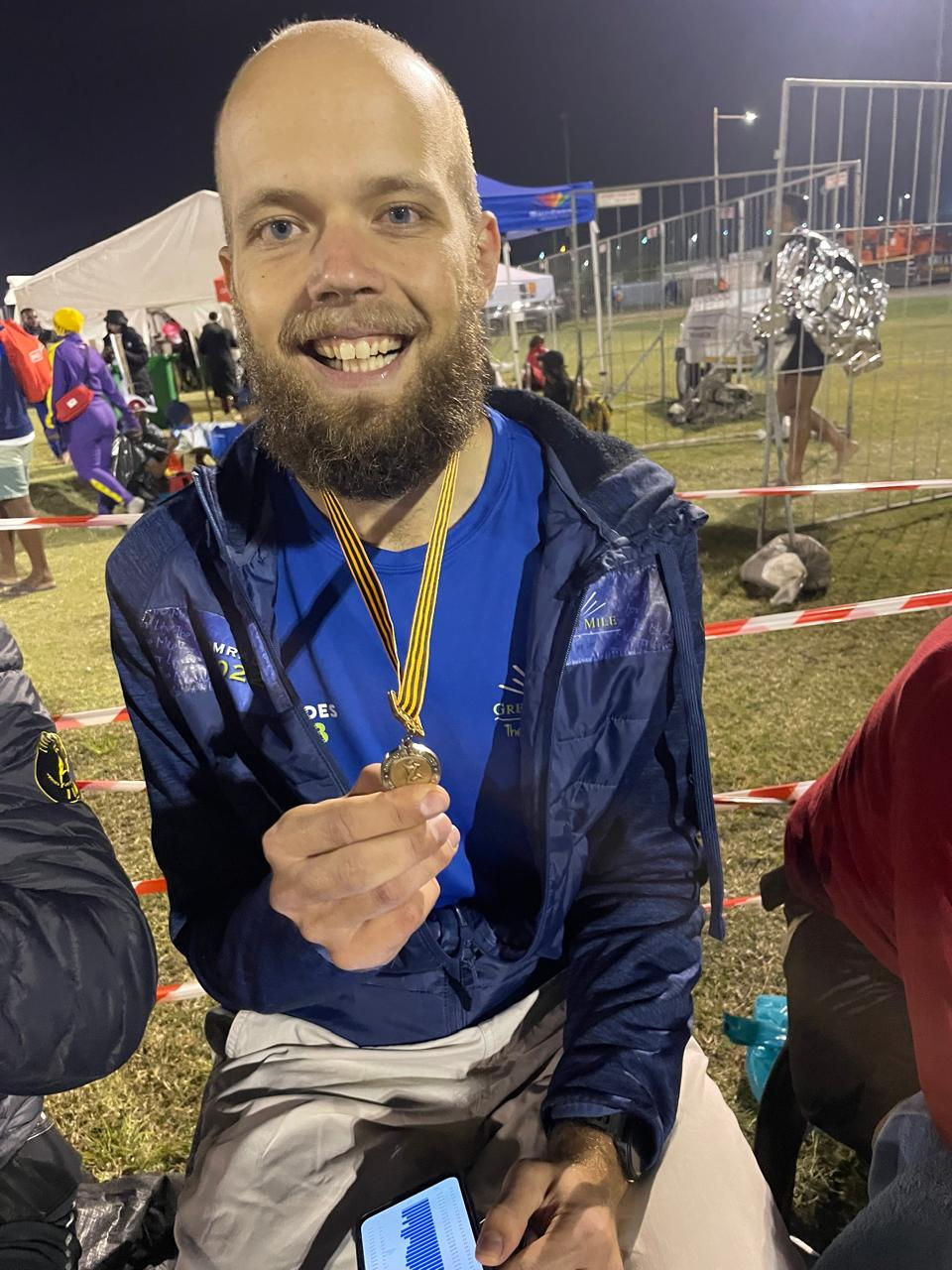
The Fanta Grape-purple turned into a ghastly brown over the second half of 2025 and as the year turned, a beautiful new pink toenail emerged to take its place. Today it is less than 4 weeks to Comrades 2026 and that new toenail is ready to take on new challenges. In many ways it is like a lover who’s heart has been broken, but after finally overcoming the trauma of past tragedy, says, “I am ready to get hurt again.”
Even though my toenail is ready to go, I have no plans to hurt it again this year. I am not going to run Comrades in 2026. I intend to spend the first few months of my second son’s life at home, and finding a new rhythm as a family of four.
(Side bar – six weeks in and it’s going great!)
So, why are we here and still talking about Comrades ?
Two reasons:
Many friends have asked me how I managed to go from a 10:22 in 2024 to a 8:56 in 2025. This series of blog posts is a summary of the principles that I followed to make such a big improvement. When I attend a braai, I try not to talk about running, because I can get a bit intense. I inevitably fail as soon as someone mentions anuthing running related, though. This post will help that whenever someone asks me the same question, I’ll simply point them to this blog.

Me explaining my methods at a braai. For my own sake, when I get to run my next Comrades (or any ultra for that matter), I don’t want to reinvent the wheel AGAIN. I want to come back and start from the principles that have already helped me to run to my potential.
I am not going to make it a bland running story, though. I am going to take you an a journey of building an optimised system. The system we're going to build, is a power plant.
Let’s get to it.
The Power Plant

I love a good analogy and that's what we'll use to describe the process of turning yourself into an endurance monster.
After watching this brilliant video about the value of easy running, I’ve come to view my body as a power plant and not just a set of muscles.
Here are the components that make up my power plant (and the blog posts of this series):
Preparing the Power Plant
a. Everything starts with Mental readiness – or designing a bulletproof control room.
b. Recovery is a maintenance crew that prevents breakdowns.
Building the Power Plant
a. Training is all about building the plant’s capacity and efficiency.
b. Strength work is about upgrading the plant’s infrastructure.
Using the Power Plant
a. Nutrition is how you fuel the power plant.
b. Hydration is how you ensure the plant runs cool enough to operate effectively.
The intention of the power plant is to run a city (my everyday life) efficiently, but have the capacity to perform under times of extreme stress (race day) without breaking.
I’m going to discuss each component in terms of the power plant analogy, share some anecdotes of why the component is so important. Where appropriate, I'll sprinkle in some more rigorous research evidence, but will try to keep things light (power plant pun intended).
(Disclaimer: I am not a running coach, nutritionist or specialist of any kind. I have learned all the lessons communicated here on my own at my own expense.)
Preparing the Power Plant
The Control Room – Mental readiness and Mindset

Before we start building the power plant, let’s prepare it for production. The first thing is to set up a Control Room from which the power plant is managed.
The main reason we start with the Control Room is that performance is limited by decision making under stress. This improves when you improve your interoception, which is your ability to interpret your body’s internal signals.
Mental preparation can go deep, but there are three concepts that I think are key to enabling you to build your Power Plant so that it can function under stress and interpret your internal signals more accurately.
Dealing with uncertainty

In the Power Plant: Your mind is the Control Room. The Control Room has a dashboard where information is displayed. When a metric goes into an abnormal range, lights flash and alarms go off. Some are important to prevent blowing up the power plant. Others are signals of hard, but sustainable effort.
Throughout a long endurance run, there are immense moments of doubt. Your internal dialogue goes something like this:
I started too fast.
I started too slow.
I didn’t eat enough.
My stomach’s feeling funny.
It’s too hot.
My Heart Rate is too high.
How is it only halfway now?
I trained for this, why is it so hard?
Are there really zebras in the middle of the road in Durban?
Why am I hearing angels singing?
Some are sure signs of catastrophic failure, but most are purely warning signs. As you gain experience, you learn to greet these warning signs as old friends – much like Penny in The Big Bang Theory and her Check Engine light . With experience you realise that the entire process is going to be hard and will continually ask you to become comfortable with discomfort. As I wrote in my blog post about Personal Bests:
Trying to run a personal best asks that you be willing to be at your personal worst.
The reason you need to prepare your power plant’s Control Room for moments of doubt is so that you can learn to interpret warning signs and not see every flashing light as a sure sign of failure. You need to learn to be at peace with that difficulty and not shut down the entire plant the moment a warning light flashes. As the old saying goes, “not everything that happens to you requires a reaction”. When my "spirit left my body" going down Field's Hill in my first Comrades in 2022, I thought my race was run. In exactly the same spot, three years later, I felt exactly the same, but managed to recognise the signal as only a warning and soldiered on.
You also need to make peace with the fact that that there could be fatal danger signals – erratic Heart Rate (HR), extreme dizziness, projectile vomiting, irregular usage of the rear exit and hallucinations to name a few. Doing hard things, mean that you have to be okay with the worst possible scenario playing out and being mentally aware enough to recognise when it is happening. You don’t want to end up like Moira Harding who stopped drinking water after 50km and ended up going on a 12 hour walkabout through Durban after the race had finished. Luckily, and by Grafe she was found and made a full recovery, but the same - or worse could happen to you.
Before you start racing, you need to know that your power plant will be put under stress and that some signals are worth paying attention to and some are worth ignoring. Feeling good all the way during an ultra is not possible. The race is simpy too long to expect no trouble.
Functioning on your own

In the Power Plant: Running together is like operating a power plant as part of a grid. Running alone is like operating in “island mode” – self-reliant.
During long endurance runs, friends often run together and come to rely on each other for support. You feed of each other’s energy and push each other forward. Especially during training, it helps heaps to run as part of a group to go further and faster than you ever believed.
Despite running for the same goal time, though, people get separated on race day. The BR team that I ran as part of Comrades 2025 started as a six man wolfpack and we all crossed the line at different times, with one DNF as well.
When you see a friend disappear in the distance, it can be a warning light that flickers in the control room. This is a sign that you need to switch your power plant from working in grid mode to island mode. You need to prepare yourself to rely on your own mental fortitude on race day to get you across the line when this happens.
In the same vein, any external resource you rely on to get to your goal, can act like an additional source of energy. A pace chart can be a guide. The best-laid race plan to tackle each of the Big 5 Hills can be a crutch and the support of loved ones next to the road can be a vain attempt at feeling better after 70km of sole (and soul) thumping agony. But these things won't really give you a real, physical ability to perform.
As a friend puts it,
After 60km, being smart doesn't matter.
So, be prepared to rely on yourself on race day. You'll have to dig deep.
Setting and forgetting your goals

In the Power Plant: You set operating targets for the power plant based on your training. The Control Room manages all the switches to try and make it possible. It needs time and repetition to get it right, though.
Given your performance at shorter distances like the 8km Time Trail, Half Marathon and Marathon, you calculate an expected goal time for an endurance run like Comrades. This is like using past electricity demand to forecast the city’s demand for a specific day.
The thing with setting goals is that they tie you into a specific outcome and can often cause you to neglect all the intricate parts of the preparation process. For endurance events, I believe in the mantra:
“Set it and forget it”
Base your predictions on your past performance and then move into a process mode of building the power plant, element by element.
That means focusing on building the plant right and using it according to specifications. Key runs in the build-up will provide the evidence that the goal is appropriately defined. This is like giving the Control Room specific stress tests to make a more accurate prediction of power plant performance on race day.
Summarising the Control Room
By preparing the power plant’s Control Room, you can start to learn the patterns of flashing warning lights and distinguish between those that are fatal and those that are manageable. You can also prepare to switch from grid mode (training with partners and relying on race plans) to island mode on race day and rely on your own ability to grind out a result. Finally, the Control Room can be prepared for a ramp up to a specific goal, but use specific test sequences at critical timepoints to know if the goal is appropriate (more on that when we Build the Power Plant).
The most efficient power plants aren’t those that don’t have warning lights – they’re the ones who know how to respond when they start to flash. They also don’t push production beyond what’s reasonably possible and cause #loadshedding on race day.
The Maintenance Crew – Recovery

In the Power Plant: Before building the Power Plant, one must commit to doing routine maintenance on the plant. This means that dedicated time must be put aside to run the plant at low capacity and prioritise the implementation of upgrades and the checking of infrastructure.
In South Africa, we don’t need to look very far to find evidence of what happens to power plant infrastructure when it isn’t maintained. But as has recently been shown, changes can be made and improvements can be seen.
There are numerous recovery protocols that you can follow, such as ice baths, sports massages, foam rolling, wearing compression garments, active recovery and nutrition. They can all be valuable.
Let’s focus on the two maintenance tasks that’ll ensure the power plant continues to operate safely: Sleep and Mobility.
Sleep – Installing Upgrades

In the Power Plant: Sleep is dedicated down time. It is a full system shutdown that allows the upgrades that were created during training to be fully installed.
In 2024, I learned that upgrades cannot be installed on the fly.
The night before the Loskop Marathon 50km race was a particularly tough one. I had slept only about 3.5 hours due to daddy duties for my baby boy. We departed for the race in Middelburg from our clubhouse in Centurion at 2:30am and arrived at 4:00am. Since this was to be our last long, long run (50k+) before Comrades, my friend Dries and I thought it apt to do an easy 6km before the 50km Ultra. By the time the race started, I had jolted my system awake enough to improve my 50km PB by 30 minutes. In total, I ran for 5.5 hours on 3.5 hours sleep. While already in dangerous territory, I had also run a 8km PB in our club Time Trial the Wednesday before the race. These factors compounded to an immense bout of flu. That sickness never went away for more than 6 months.
The point of this story is that ultrarunning can be done with minimal sleep on race day. The adrenaline of the day ensures you’ll be OK. The Control Room knows how to manage the warning signals for the day.
Training for an Ultra, however, requires months of careful management of training and recovery. It is simply not sustainable to try and run at your best if you do not prioritise sleep.
Your body needs time to adapt to the rigours of training.
Let me also say this: running Comrades is not normal. It is a wild and crazy event that also requires a lot of time for your mind to ease into the idea of running 90km. Do not let crazy veterans tell you otherwise. This means that you need time to acclimatise mentally to the rigours of training. In the power plant analogy, down time also gives the Control Room time to calibrate its instruments to new levels of performance.
Start your Comrades training with a good sleep routine. Follow people like Matthew Walker and Andrew Huberman on Social Media if you want to learn what that looks like. I cannot stress the impact of a good sleep routine enough. When running sleep-deprived, you think that your issues are performance-related and you push harder, creating a vicious cycle. If you can’t settle on a good sleep routine and find that your training is struggling, consider setting an easier goal. There’s no shame in it and it’ll feel way better than having your moment of reckoning at 60km of Comrades as I did in 2024.
Sleep more than you think. It is the most powerful recovery tool you have. This’ll mean leaving social events early and becoming a nap king whenever you can sneak one in. Sleep to protect the Power Plant!
Mobility – Greasing the Gears and calibrating sensors
In the Power Plant: Mobility work is the maintenance crew that spend their time lubricating conveyor belt pulleys, calibrating instruments, tightening loose screws and ensuring that systems run under minimal frictional load.

My definition of mobility covers a broad spectrum of exercises such as static and active stretching, yoga, pilates and breathwork.
As an office worker, I spend most of my time sitting at a desk with poor posture. I also work from home, which means that if I don’t run, I often don’t move around a lot during the day. I’d wager that my step count is pretty low for an ultrarunner. The consequence is that I am extremely stiff, especially in my hamstrings, hips, quads and adductor muscles.
After my traumatic Comrades 2024, I decided to make time to focus on these problem areas. I started by watching videos from YouTube channels like Julia Reppel and Strengthside. After a few months of doing at least two mobility workouts per week, I finished a workout with a standing hamstring stretch. I could almost put my palms flat on the floor with straight legs after barely being able to reach my toes at the start of the process. As I unfurled from this stretch I had what felt like a religious experience. My body was so grateful for the practice. After years of running with no regard for how my body felt, I took a lot of inspiration from this quote from one of the first videos on my mobility journey:
“I used to not listen to my body. I used to beat up my body, because I thought that that’s what men do. These days I choose to move freely and feel good.”
In the power plant analogy, I had neglected to tighten loose screws, the conveyor belts were running off centre and I was tapping on and fiddling with instrumentation gauges for months without realising that their readings were incorrect. Once I had been consistently applying the practice, I could start building the power plant from a stable physiological base. If there's one lesson for you to take from this recovery section, let it be this:
If you take care of your body, your body can take care of training.
The secondary point of mobility work for me, is not so much the increased flexibility, but the way that it teaches you to connect with your body – there’s that word again, interoception. In the power plant analogy, the mental side of effective mobility work is when the sensors in the plant are upgraded to reflect more accurate data in the control room.
I don’t follow strict routines anymore, since I have a whole armada of stretches, poses and movements that I know from following a few videos. What I do, is that I identify an area that feels particularly sore or tight and focus on it. I move it in different directions to understand how and why it feels the way it does.
For example, when I do speed workouts, I’ve learned that my calves are always tighter than usual. After a long run, my left quad muscles tighten and my pelvic floor muscles are fatigued. After a trail run, the smaller muscles in my core and ankles are noticeably more sore. After long hours of sitting behind my desk, my mid back and hip flexors seizes up and I need to do extra work to activate my glutes.
This practice helps me to gauge whether a difficult run was because of something physical that needs addressing or if there was a mental aspect that I neglected. It’s also really easy to know when you’re coming down with a kindergarten-induced post-nasal drip when you’re in an upside down yoga pose.
Why Mental Training and Recovery comes first
Without mental preparation and resilience (Control Room) and recovery (Maintenance Crew), training becomes noise, injury risk skyrockets and improvements stall.
Recovery enables you to train better, but it’s benefits aren’t purely physical. Your power plant doesn’t get stronger during the hours of producing electricity – you get stronger when the plant rebuilds itself after.
By committing before training starts to think about the Mental aspects of the journey, the Control Room can constantly be calibrated to give more accurate information. This will enable you to understand what warning signs are fatal and which are encouragement to keep pushing. If you are well recovered on race day, you will have enough mental capacity to interpret these signals accurately and fly to your goal.
Once the control room is calm and the maintenance crew is doing its job, you can start upgrading the plant itself. In the next post, I will share how to build a Power Plant and how I built my own during my Comrades build-up of 2025.


The Power Plant analogy does make sense. It covers various angles, especially the management side. The plant manager needs to be experienced to understand the flashing lights and alarms. It's almost like an experienced driver parallel parking, while using the park assist to park. They flash and scream danger, but an experienced driver knows he has 5 more centimeters of space, or nothing at all, while the same alarm keeps yelling, whether the distance is 1cm or 5cm. Interpreting the signals is so important, to know you can keep pushing, as you know the body can do more, or do you stop, and walk when knowing a fatal breakdown is close.
9 out of 10 times, the park assist will…